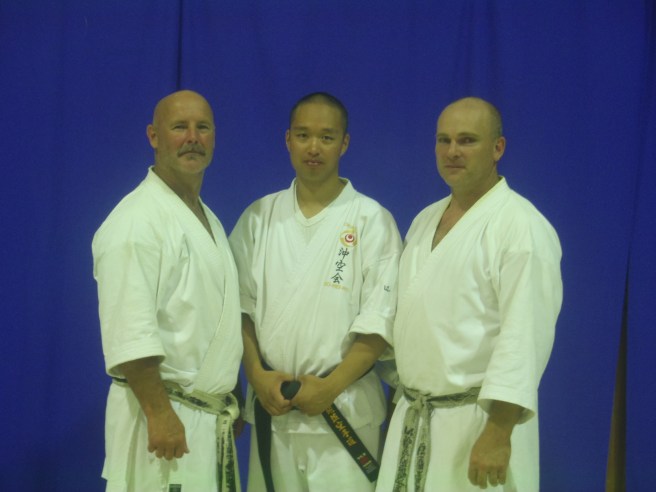
Gasshuku Karate Camp Canada 2011

The Gasshuku Karate camp is known for their very hard-working approach to traditional Karate training. The lead instructor is Sensei Ron Fagan and along with his Senpai Budrow, both are senior ranked in Chito-Ryu Karate. Sensei Fagan is a technician and innovator in karate instruction and practices.

After years of hearing how great the training is at Sensei Ron Fagan’s Karate camps, I had to experience this for myself. From a special invitation from a friend, Sensei Charles Quimby invited me to travel with him and his students to the camp this year.
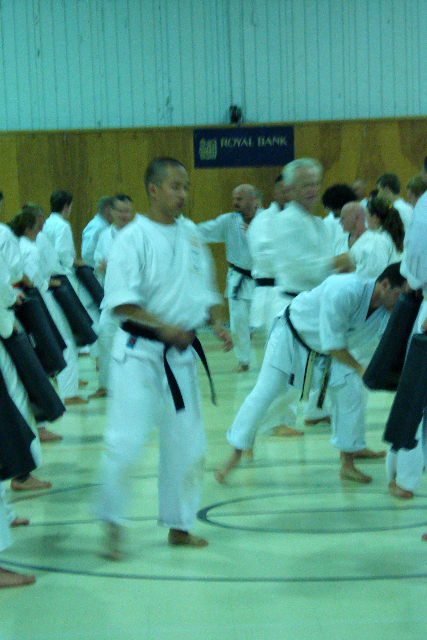
The three day camp was full of scheduled activities to keep all the participants busy. It was evident that the organizers came up with a thorough plan and I had to say they executed it very well. The camp consisted of scheduled training sessions with appropriate breaks.

The start of every training session consisted of warm up exercises that involved medicine balls, with the incorporation of calisthenics. Then the sessions lead into specific focuses, that worked kicks, sweeps, footwork, and kata. At the end of each session, groups were formed and pitted against each other for friendly competition. The competitions were primary non-martial arts related, like making a basketball shot or completing a small puzzle. The interesting part was the losing team had to stay back at the end of the session and perform calisthenic exercises.

“I don’t think we are better then anyone else, we just train different.”
Ron Fagan Sensei

I thoroughly enjoyed the practice of techniques in a breakdown to isolate specific aspects, techniques that may seem elementary, but never the less was appreciated no matter of age, gender or rank. The organization and synchronization of practice with over 60 practitioners at the camp was very inspiring to experience.

The camp in general gave me a re-invigoration for Karate practices and for my martial arts in general. The generous attention and knowledge I received gave me many things to revisit in my martial arts.

“Good Karate is good Karate, no matter what the style.”
Ron Fagan Sensei

What is Joe Lewis talking about?

Joe Lewis’ Top 10 Martial Arts for Self-Defense

http://www.blackbeltmag.com/daily/mixed-martial-arts-training/boxing/joe-lewis-top-10-martial-arts-for-self-defense/

Joe Lewis is definitely a well accomplished martial artist and I respect him very much for what he has done for martial arts, especially in America.

Black Belt Magazine published Lewis’s recent decisions on which martial arts is most effective for self-defense. I can agree to why Lewis chose the martial arts that he did except for one.

What the hell is Outlaw Tai Chi?

I come from a family of Tai Chi practitioners and they never heard of such thing. I am not the only one to question this decision. I think Black Belt Magazine or Joe Lewis him self needs to explain.

Does anyone know what is Outlaw Tai Chi, because I don’t.

RORY MILLER Self Defense Expert & Innovator

Coming to the Boston Area September 2011…

.

…Martial Arts Instructor  …Veteran Corrections Officer/Tactical Team Sgt and Trainer 

…Use of Force Policy Designer  …Police Defensive Tactics Trainer


 …The original ”THUG WHISPERER” and an overall Very Cool Teacher

Rory is a Nationally Acclaimed Author on the subject of Awareness of and Surviving Violent Encounters


Meditations on Violence : A Comparison of Martial Arts Training & Real World Violence

       R. Miller, Author/Trainer

Facing Violence:Preparing for the Unexpected

Most people understand violence occurs and is a fact of life.  

Your MA, MMA and Self Defense Training might be the solutions… 

Shouldn’t we spend some time STUDYING THE PROBLEM?

.

BASIC INTRO to VIOLENCE

The 7 – Essential Aspects of  Self Defense

8 HOURS (Includes Lecture & Drills)

Saturday, September 10, 2011

9:00am – 5:00pm

Norwell Karate School

142 Main St. Norwell, MA

.

CONFLICT COMMUNICATIONS

Professional Articulation Skills (CONCOM)

6 HOURS  Skill Building Course

Sunday, September 11, 2011

9 AM  – 3 PM (tentatively)

Institute of Okinawan Karate-do

28 Chestnut St. Quincy, MA

.

$80 per class,
 $120 for both full days

SOME OF THE TOPICS COVERED

Violence Education (Predators, Myths, etc.)

Making Physical Defense Work

Adapting Training Methods to Reality

Adrenaline Stress Training

Using the Environment as a Tool

The Aftermath of Violence

And much more!

Not to miss exclusive opportunity to explore the dynamics of social conflict, real world assaults and ambushes.

  • An invaluable COMPLIMENT to any Self Defense, Martial Art/MMA or other sport training!


  • SUPERGCHARGE everything taught in National Self Defense Curriculums (“RAD”, “Fight Like A Girl” women’s program, etc…)


  • Add FORCE LAW ARTICULATION to your toolbox.  Don’t end up in jail for being the good guy!


  • Make your already effective skill set APPROPRIATE and EFFICIENT
  • Hear Principals explained that most good instructors know intuitively so you can LEARN TO TEACH YOURSELF.

More info. About Rory Miller at Chirontraining .com


For more info. on this seminar call Billy G. at (617) 592-5893

Black Belt Magazine’s Wing Chun Grandmaster William Cheung’s Technique Post (Combative Breakdown)

Wing Chun Kung Fu Grandmaster William Cheung Shows You How to Deal with Low Kicks From a Muay Thai Fighter!

A post from Black Belt Magazine. http://email.blackbeltmag.com/t?r=11&c=5974&l=11&ctl=466B8:BD1B6880428B636E3E06B980D4348693&%20martial-arts-dvd-preview-for-william-cheungs-street-fighting-applications-of-wing-chun-volume-3-muay-thai-melee

David Chan here after years of training and continually devoted in the studies of the combative arts, is here to breakdown an online post about martial arts.

This video shows Grandmaster William Cheung shin check an opponent’s rear low roundhouse kick. Grandmaster Cheung uses the checked leg to perform a huan guer (circle leg footwork) to move to the outside of the opponent. Then Grandmaster Cheung executes a series of gum sau (pressing hand) to the opponent’s lead hand and punches to the head.

First I understand that this video is only a small slice from Grandmaster Cheung’s new instructional DVD.

Lets address some of the most common comments.

The basic Muay Thai kicking technique is taught to finish the kick by returning the kicking leg back to the original fighting position, in the video the attacker does not do this. I can see several reasons why this is not performed. One is when the leg is checked the gum sau is performed almost simultaneously right after the shin check, the opponent does not have the opportunity to retract the kicking leg without being unbalanced falling forward. This would also mean that due to variables in hand/arm positions, the gum sau may need to become a grab and pull. Another possible outcome is when the kick is shin checked strong, the shin check created so much damage that the opponent neglected to return the leg, but this is not always the outcome.

What happens if the opponent does return the kicking leg back to the original fighting position?

This would mean Grandmaster Cheung would end up in the inside of the opponent. Though this is not the most favored situation to be in, Grandmaster Cheung can be in position to now face the opponent squared off with the opponent’s legs and feet in a neutral position, which means the opponent has to reposition to be more defensive or offensive.

What I would like to see.

I would like to see more. It would be interesting if Grandmaster Cheung addresses any of the common questions in the DVD. I think Grandmaster Cheung needs to show other variables that can happen, especially if you are talking about street fighting.

Thank you Black Belt Magazine for the post.

Filipino Martial Arts Training

Doce Pares New York definitely offers the best Filipino Martial Arts training around. I attended the one day Doce Pares Instructor Development Course. Sonny Mayo Sensei is an absolute gentleman, and was respectful of the fact that everyone that attended the seminar is from different martial arts disciplines. The material was presented in a clear, organized and systematic manner, which allowed for easy learning. Mayo Sensei is very approachable and had an open mind during instruction which reflected among the good character of his staff at the academy. I believe anyone that is serious about martial arts needs to learn this style.

Does the U.S. Army’s Combatives system include too much BJJ?

I was online today and found a good article with a video of Matt Larson speaking about the Modern Army Combatives Program (MACP). Matt Larson answered a popular question that has plagued many top MACP instructors from their soldiers. After watching the video I feel Larson answered the question very well, and to my expectations. Even with my strong striking martial arts foundation, I believe that a grappling style martial arts is the best system to be implemented to modern soldiers, and what better system to use then the Jiu-Jitsu from the Gracie family.

You can watch the video here at http://www.blackbeltmag.com/daily/self-defense-training/combatives/matt-larsen-does-macp-include-too-much-bjj/

Karate’s Body Conditioning

At a special evening class at Okikukai Headquarters, most of the current high ranking Shohei Uechi Ryu Senseis including the current Okikukai President Nakahodo Sensei was in attendance.

The class was a traditional class with junbi undo and hojo undo at the beginning of class. Then came the kotae, a regular body conditioning exercise phase that is heavily emphasized in the Uechi Ryu style of karate. Every student was asked to take off their gi tops, and then was asked to break up into three groups to be tested in sanchin. Sanchin testing is very helpful in not just body conditioning, but allows the practitioner to have full one on one guidance from the instructor.

Okinawan Karate Master Exclusive

The person on the left is Yoshi Arakaki Sensei the President of the World Association of Uechi Ryu Shobukan and Kobudo Master on Hamahiga Island. The person on the right is a worker at Yoshi Arakaki Sensei’s Hamahiga Sea Salt factory.

My Sensei from Okikukai brought me here on a very special trip. Yoshi Arakaki Sensei gave us a exclusive tour of his sea salt factory and the bay where he pumps the water from the sea. Then he gave us a tour of his village, which is not very far from his factory. The village is small, but is rich with history and culture. The people on Hamahiga island live a simple life in a country setting and can easily travel to Okinawa by way of a bridge that links the two islands together.

I was interestingly surprised when Arakaki Sensei told me that the people of Hamahiga Island are mostly descendents of Samurai clans. Arakaki Sensei said that even his great grandfather was a Samurai. We were given exclusive entrance to a shrine which was built to preserve their family’s’ history. In that shrine Arakaki Sensei showed us pictures of his family on a wall, which included his father, grandfather, and great grandfather. At the foot of the wall below the pictures on display is a dark wooden staff. Arakaki Sensei said the staff originated from China and has been in the family since his great grandfather.